Proto-Questions

Some PhD candidates think that the way to be ready for the viva is to consider as many questions as possible: list them, think about them, maybe make some notes. But there are just so many questions that someone could be asked. Too many to consider all of the reasonable questions that might occur!

  • Why…? How…? What…?
  • When…? Where…? Who…?
  • And let’s throw in “Which…?” for good measure.
  • And “Why did you…?” and “How did you…?”

These nine little phrases are the beginnings of many questions. Each one could connect with your general research area and your particular PhD research topics in countless ways.


Rather than make notes for 1001 specific questions – or even keywords to help with the proto-questions above – simply make the time to find opportunities to rehearse for your viva.

Don’t focus on the mass of possibilities you could face at the viva. Face up to any concerns by practising responding to relevant questions and build your confidence at doing well in the discussion your examiners will prompt.


PS: Find more viva help in the latest collection of Viva Survivors Select, The Contribution Issue, newly released this week. Don’t make notes for 1001 questions but do consider how you would explain what your contribution means to your examiners.

All Your Hours

Something like 5500 to 6000 hours of work might go into a full-time PhD journey.

(that might be more hours as well if you’re a part time researcher…)

Thousands of hours of reading, writing, making notes, practical work, meetings, seminars, learning, developing, growing, creating and making and improving – and thinking.

So many hours of thinking.

When you bring all of that together and really consider how much you’ve invested into your journey then you will find some confidence for your viva.


PS: The many hours of your PhD journey lead to significant original contributions in your thesis. The latest Viva Survivors Select, The Contribution Issue, explores contributions from many perspectives. Take a look if you’re looking for more viva prep or confidence building help!

Expecting Examiners

There are general expectations of all viva examiners and specific expectations for yours.

In general, examiners are experienced academics with training to examine a PhD thesis. They’re supported by their institutions and colleagues. They invest time in preparing for your viva, want you to succeed if you can and want to do their part well.

There are no good cops, no bad cops, no gotcha questions – but there might, because of the nature of the viva, be challenging questions that they have to ask as part of the exam.

Any examiners could be expected to fit the description above – but you don’t have any examiners.

Your examiners might follow your preferences in their selection. You could suggest a person or kind of person to fill the role and your supervisor might follow that suggestion. When they’re approved, you can get a sense of what you might expect from them by finding out more about them.

You can read their most recent publications to have a sense of their current or recent focus. You can look at their pubic staff webpages to know where their general interests lie. You can consider what all this means for what they might do specifically at the viva.

To really know what to expect from your examiners you have to consider the general and the specific as you get ready for your viva.

What-How-Why

When you look back at a difficulty you overcame during your PhD, consider:

  • What was the problem?
  • How did you resolve it?
  • Why did this have an impact?

It’s all too human to gather problems together into a big pile of negativity. Looking back at PhD challenges and problems it can be all too easy to be overwhelmed.

Instead, get focussed and specific when you think back on PhD problems. Focus on one problem at a time. Use the questions above to help you get past any lingering concerns.

Get things sorted so that you can then focus on the far more important and helpful things that you want to talk about at your viva.


(offered as another tool in the mould of Why-How-What!)


PS: The latest issue of Viva Survivors Select 12, The Contribution Issue aligns with the kind of reflection I’m talking about in today’s post. Overcoming difficulties and problems correlates with making contributions. Find more reflections and tools in the new issue!

Lucky & Fortunate

It’s important to properly frame the role of good fortune in a PhD journey or in viva success. Words matter – and the words you use to describe your progress and achievements have an impact on you and on others.

Lucky could happen to anyone but fortunate is down to you and your efforts.

Fortunate means you worked hard and enough of that hard work paid off.

Lucky means your actions didn’t matter. Anyone could have done it and it just happened to be you.

Whatever your research, remember that you’re not lucky: you’re fortunate.


PS: The latest issue of Viva Survivors Select 12, The Contribution Issue came out yesterday! Reflecting on your thesis contributions is a useful reminder of how your success really is down to good fortune and not luck. You’ll find a lot more in the issue too so please do take a look if you’re looking for more viva help.

Viva Survivors Select 12

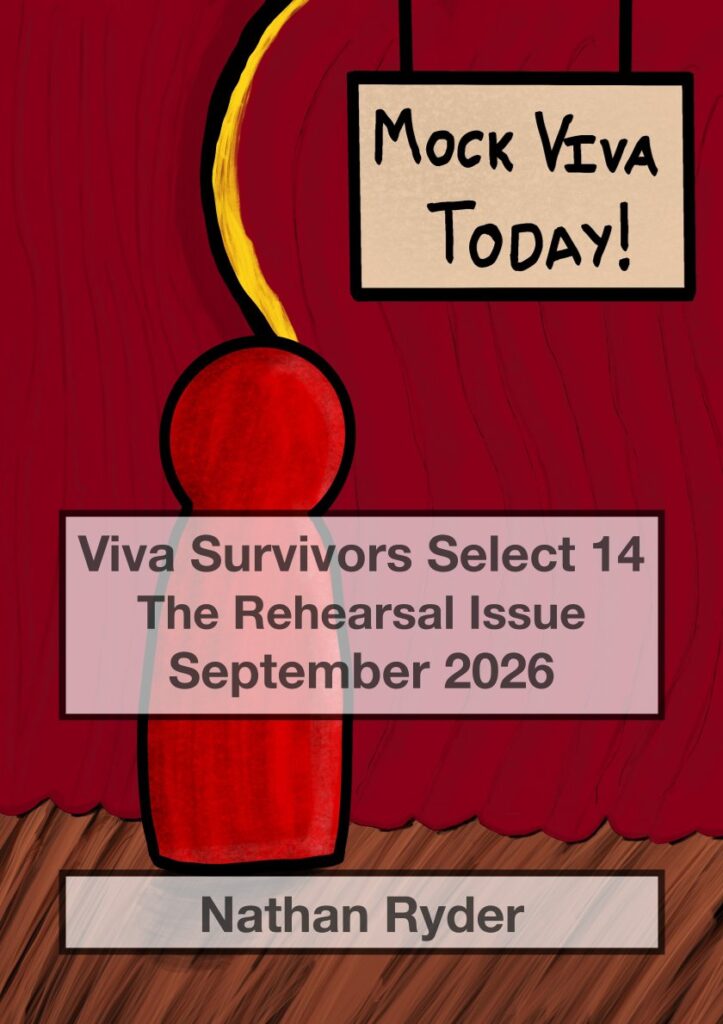
Cover for The Contribution Issue, dated July 2026. Background image shows a red stylised pawn on a ladder painting a large mural. A blue pawn has a ? speech bubble at the foot of the ladder

It’s release day for The Contribution Issue, the latest issue of Viva Survivors Select!

You can find The Contribution Issue on my Payhip store now. This issue is an exploration of what it means to make a significant, original contribution – what that means for a PhD candidate, how they can prepare for the viva and how they can use their contributions to help build up their confidence.

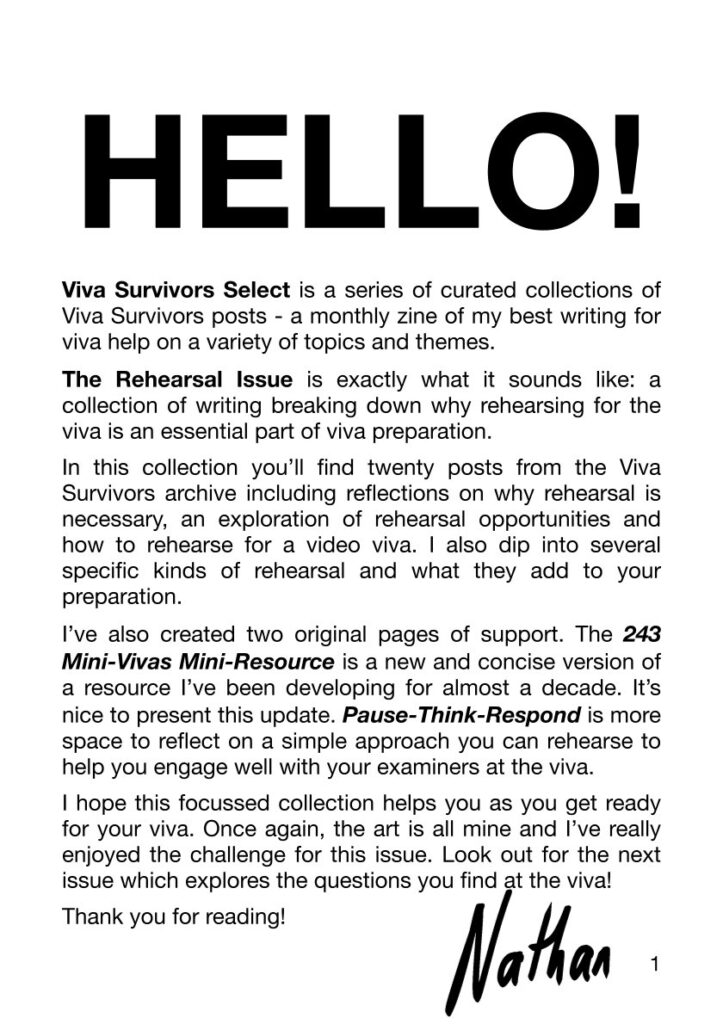
Page 1 of The Contribution Issue, titled HELLO! - an overview of the issue's contents

The Contribution Issue contains twenty posts from the Viva Survivors archive as well as two original pages of viva help. For one I get a little bit reflective myself and think back on my PhD and what my understanding of my research contribution meant for my viva. I also share a daily reflection tool for building up a summary of thesis contributions. And once again I’ve done all of the art – I’m really enjoying making art a part of what I do in 2026 🙂

Page 3 of The Contribution Issue. A post titled "Contribution is Cumulative" takes up the first half followed by a black and white image showing a pawn character standing on top of a tower of blocks

Viva Survivors Select 12, The Contribution Issue, is out now for £3. If you like the blog, want more help and want to support what I do then please consider buying Viva Survivors Select. If it helps you then please pass on details of The Contribution Issue and Viva Survivors Select to anyone you know who is looking for viva help.

Thanks for reading!

Nathan


PS: the next collection, The Personal Issue, is due out on Wednesday 12th August 2026!

The Viva Essentials

What do you need for a viva?

You need to have a significant, original contribution to research from one or more projects that you’ve completed over (at least) several years.

You need to have a well-written thesis which, in some way, describes the research.

You need to have read the regulations for your institution and learned what to expect generally from a viva.

You need to have two suitable examiners (or sometimes more) who are going to prepare for and examine you at the viva.

You need to prepare for your viva.

You need to make sure that the university makes any necessary adjustments to the viva process to meet your specific needs, if you have any.

You need to show up on the day, ready to engage as well as you can with your examiners’ questions.


What else do you need? If you can think of something, how will you get it?

Today & Tomorrow

You can’t change the past even if you wanted to.

You don’t get a do-over if you faced difficulties in your PhD or have regrets for something that could have been – or if you simply know more now than you did then.

Whatever happened, whatever the reason, today you can change course. Today you can decide that the past doesn’t define you. You can go a different way.

Today you can change course and tomorrow you can take action. And, importantly, you can do this again and again, steering yourself closer and closer to who you want to be for your viva.

So what do you want to achieve for yourself before your viva? How do you want to present yourself and your research at your viva? How might you change course? And what will you do to get to your destination?


PS: my final 7 Reasons You’ll Pass Your Viva webinar is running tomorrow morning, Wednesday 15th July 2026 at 11am. This is my last webinar before my summer break – so I’ve decided I’m really going to make it a good one! 😉 Registration includes a catch-up recording, follow-up email and my pdf guide 101 Steps To A Great Viva. Hope to see you there.

Final July Webinar!

“Hi Nathan, Thanks for your time and for setting these up – often it helps to hear about [the viva] from someone not in the department/same uni to get a broader perspective. I felt so assured when you said you’re more likely not to submit a final thesis than you are to fail a viva – so in a way that will make me have a much better summer knowing the hard slog is actually 90% over. I liked the structure of the session as well as your willingness to answer questions and interact with us.”

– PhD Candidate, University of Leeds

These very kind words from a recent attendee at a 7 Reasons You’ll Pass Your Viva session were a big boost. It felt like they got exactly what I’m offering with these sessions. It was so nice to receive this feedback 🙂


My final viva help webinar before I take a summer break is this Wednesday morning. Bizarrely it will also be the 100th time that I’ve delivered the session.

I say bizarre because it had such strange beginnings: 7 Reasons You’ll Pass Your Viva was something small I did to try something new during the first COVID lockdowns in April 2020. I was only going to run it once, maybe twice, but it has grown to be one of my most-requested webinar sessions.

I really love sharing this 1-hour confidence-boost for the viva and seeing how it resonates with PhD candidates. The session is designed to be a confidence boost, concise and valuable, with plenty of time for questions too.

Tickets for my final 7 Reasons You’ll Pass Your Viva session of the summer are available now. If you’re looking for viva help then I hope you can join me on Zoom this week:

Registration for this live 7 Reasons You’ll Pass Your Viva webinar is £20 and includes a follow-up email, a pdf copy of my 101 Steps To A Great Viva guide and access to a catch-up recording of the session.

Thanks for reading! I hope to see you there – and if you think this might help a friend with their viva prep or viva nerves then please share this message with them.

All the best,

Nathan

A Problem

When you have a problem in your research there are a lot of questions that someone could ask.

  • Why is it a problem?
  • How is it a problem?
  • When did you realise you had a problem?
  • Did you resolve it? How did you do this? Did you have to try anything else first? And can you think of any other way you might have approached it?
  • Was this a one-time problem? A recurring problem? Is there literature about this kind of problem – or even this specific problem?
  • What does it mean to resolve this problem?
  • How have you felt the impact of the problem?
  • How would you advise someone else who faces this problem or similar in the future?

When you have a problem in your research there are a lot of questions that someone could ask – and someone could be one of your examiners.

Consider the problems you’ve faced in your PhD before you go to your viva. The fact that you have faced problems is not negative: it means there plenty of things to talk about which can demonstrate your capability.

1 2 3 351